The differences between individuals' actual and desired holdings of money are the proximal causes of them affecting the level of spending in the macroeconomy. These differences between actual and desired money balances appear economy-wide when we have inflation or deflation. Function must relate the demand for real balances only to real variables (usually including a real rate of return differential that is the opportunity cost of holding money7 and a real transactions quantity). The money demand relation then implies that the steady-state inflation rate will equal.
- Real Money Balances And Inflation Definition
- Inflation And Money Supply
- Printing Money And Inflation
- Money Growth And Inflation
In the models we have presented so far there is no role for money. In this lecture we allow for the role of money in the exogenous growth models we have analyzed. Money is a unit of account and a means of payments, which reduces transaction costs, and a liquid store of value (asset) which pays no interest. We first present a representative household model in which real money balances enter the utility function of households, and then analyze a corresponding model of overlapping generations.
In models with money, one can draw the distinction between real variables, as the ones we have analyzed so far, and nominal variables, such as the price level, inflation and nominal output, wages and interest rates. Nominal variables are expressed in terms of money, which has three functions. It is a unit of account, a means of payments and a store of value. By assuming that money enters the utility function of households, we derive a money demand function from microeconomic foundations, as a result of the solution of an inter-temporal optimization problem by households.
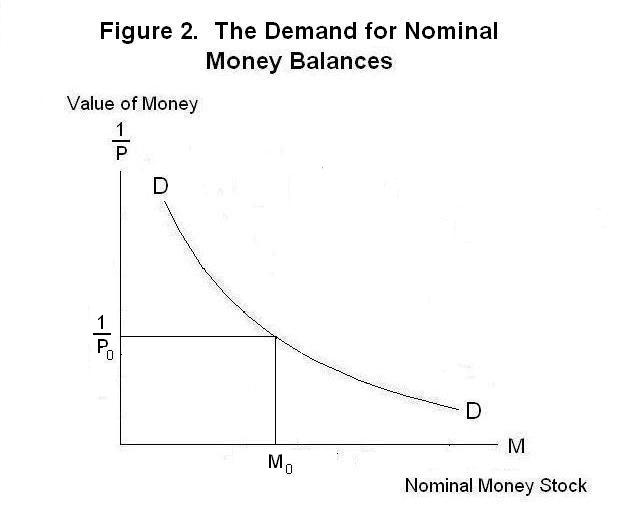
Based on this particular approach to money demand, we can show that the demand for real money balances is proportional to aggregate consumption, and depends negatively on the nominal interest rate, since money is an asset that pays no interest. The nominal interest rate measures the opportunity cost of holding real money balances. The demand for nominal money balances is proportional to the price level, a property which implies the neutrality of money. The stock of nominal money balances does not affect any real variables, but only the price level.
We can also analyze the determination of inflation, the nominal interest rate and other nominal variables, and the inter-temporal effects of the rate of growth of the money supply on the path of economic growth.
In the representative household model, the growth path of all real variables, with the exception of the stock of real money balances, is independent of the rate of growth of the money supply, which affects inflation and nominal interest rates. The demand for real money balances, which depends negatively on the nominal interest rate, is the only real variable that is affected by the rate of growth of the money supply. This is because the rate of growth of the money supply imposes an inflation tax on the real money balances held by households. The independence of the growth path of all other real variables from the rate of growth of the money supply is known as the super neutrality of money.
In overlapping generations models, the rate of growth of the money supply affects the growth path of all real variables, as it affects the aggregate savings rate, the accumulation of capital and the balanced growth path. The reason is that in overlapping generations models, holdings of real money balances differ among generations. Thus, when there is an increase in the rate of growth of the money supply, older generations, which hold higher real money balances, reduce their asset holdings and their consumption more than younger generations, since they pay a higher inflation tax. As a result, aggregate consumption falls, and aggregate savings rise. This leads to a higher accumulation of capital, which affects the growth path.

The differences in the effects of the rate of growth of the money supply between representative household and overlapping generations models arise for the same reason that government debt has no real effects in representative household models, while it has real effects in overlapping generations models. Ricardian equivalence and the super neutrality of money are closely linked, as the rate of growth of the money supply is essentially an inflation tax on real money balances, and has different effects on older and younger generations.
In the representative household model, neither government debt nor the growth rate of the money supply redistributes the tax burden among generations. In overlapping generations models, both result in a redistribution of the tax burden among generations, and thus affect the aggregate savings of current generations. An increase in public debt redistributes taxes from current to future generations, causing an increase in consumption by current generations, while an increase in the rate of growth of the money supply redistributes taxes from future to current generations, causing a reduction in consumption by current generations.
Governments in most developed countries typically finance a budget deficit (the gap between government spending and tax receipts) through borrowing from the domestic or foreign private sector. Occasionally, if they can’t raise enough revenue through selling bonds to the private sector, they can get the central bank to print money to buy the bonds. This is debt monetization. This is quite rare in developed countries but it is more likely in developing countries where there can be crises (eg wars) that lead to a collapse in the ability to collect taxes, so deficits can rise beyond the government’s ability to raise revenue through borrowing. It can also happen when lenders fear sovereign default, and begin to demand ates of interest on government borrowing that the government cannot afford.
The revenue gained by government by printing money is called seignorage. It is effectively a tax on real money balances.
The seignorage revenue received by the government is . We can multiply the expression by just to give us an alternative way of writing it.
, in other words it is the rate of money growth multiplied by real money balances.
Inflation approximately equals nominal money growth minus output growth , so in the short run where there is no output growth, growth .
So we can write the expression for seignorage as being , ie it is inflation multiplied by the amount of real money balances in the economy (hence it being a tax on real money balances).
This is pretty effective tax because you can’t avoid it. Anybody who holds money effectively pays the tax because their money becomes worth a little bit less but the government is getting free money to spend on its spending programmes.
There is a complicating factor here, because the demand for money declines as inflation rises. You can express money demand in the form , ie the demand for real money balances is a function of income (or output), and peoples liquidity preference schedule (how downward sloping the money demand curve is). Note that it is a function that is increasing in terms of income (the richer people are the more money they want to hold) and declining in terms of nominal interest rate (when interest rates are higher, people want to hold less money and more bonds or other forms of illiquid assets).
You can write this in terms of real interest rates as .
Over time, income, the real interest rate, and expected inflation can all change. But it is useful to think of what would happen in the ‘super short run’ (like month by month timescales) when modelling seignorage, because the big risk with seignorage (as will be explained soon) is that it triggers very high inflation, where inflation changes very quickly over a time scale where the real interest rate and income are more or less static.
So to model this we will assume that income and real interest rate stay constant and the variable factor is expected inflation: , where L (demand for money) and hence seignorage, is declining in .
Real Money Balances And Inflation Definition
This implies during times of high inflation, money demand depends mainly on expected inflation. As expected inflation rises, money demand falls. This is basically because as money is losing its value quickly, you don’t want to hold it for very long – higher expected inflation increases the opportunity cost of holding money.
However, in practice the real interest rate may become very negative because the nominal interest rate does not keep up with inflation, so you are not always better off holding bonds either! And it is hard to put your money in bonds fast enough, it may not be practical. So instead people start bartering goods, they start demanding wages more often (eg twice a week), or they start using a hard currency (eg dollarization). As inflation rises rapidly, people do whatever they can to avoid holding cash, and demand for money collapses.
Think about what is going on here. On the one hand, increasing money growth, is increasing the rate of the inflation tax (so seignorage is rising), on the other hand, increasing money growth is increasing inflation and decreasing money demand and so the amount of real money balances being held in the economy (so seignorage is falling). There are two effects working against each other here.
We have two equations: and .
Inflation And Money Supply
We can combine them to get: , where L (demand for money) and hence seignorage, is declining in .
Now think about what would happen if we had constant money growth. Over time, inflationary expectations would adjust to the constant level of money growth, they would catch up with it, so . Here is entering the equation twice. Inflation is increasing in it directly and declining in it indirectly via inflationary expectations and falling money demand. At the start the indirect effect is small but it becomes large quite quickly, eventually outweighing the direct effect. There is therefore a hump shape like a Laffer curve, in terms of the amount of ‘tax’ (seignorage) that can be collected in this way. There will be a rate of constant money growth which optimises the amount of seignorage revenue.
Example: suppose the economy has GDP of 100. The real money stock is given by the money demand equation where and so .
To find the rate of constant nominal money growth that would maximise seignorage we start with the equation remembering that in the case of constant nominal money growth, .
So .
So to optimise this we differentiate and set equal to zero so .
This tells us that the optimising rate of nominal money growth is 48.5%. With this level of money growth we could raise seignorage revenue of ie we can raise maximum income of 23.523 through seignorage. Given that GDP is 100, this means the maximum budget deficit we could cover through seignorage would be 23.523% through seignorage.
Now what would happen if the budget deficit was actually 28%, ie we needed to raise income of 28 through seignorage. We can’t do this keeping constant money growth, the only way we could do this is to hike up nominal money growth above the level of expected inflation. We can get away with this in the short run, but inflationary expectations will catch back up with our new level of expected inflation.
Remember that in our short run with no growth, , so when we have money growth of 48.5%, we already have inflation of 48.5% (not a good situation to be in). So inflationary expectations will be 48.5%.
What rate of nominal money growth could get us seignorage revenue of 28 with inflationary expectations of 48.5%?
. So we need money growth of 57.73% which means inflation of 57.73%. In the short run we can get the required level of seignorage with this higher level of inflation, but what happens when inflationary expectations catch back up to the new level of money growth? We will have to do the equation again, with 57.73% as the new value for expected inflation. This will imply that we need an even higher rate of money growth, and hence inflation, to hit our seignorage target.
Printing Money And Inflation
The moral of the story here is that there is an optimal rate of seignorage revenue that you can generate (depending on the parameters of the money demand equation) through constant money growth.
Money Growth And Inflation
If you want/need to raise seignorage revenue higher than that, you have to do it through increasing money growth. This means you are going to trigger an inflationary spiral, and this is how you end up with hyperinflation.